Hawke’s Bay Regional Council in collaboration with Frank Engagement
The challenge
Hawke’s Bay Regional Council (HBRC) was preparing to launch the biggest shift in regional public transport in over a decade with a simplified, faster bus network that better connected Hastings and Napier.
Launched on 25 January 2026, the Better Bus Routes launch required significant behavioural change for existing users, particularly those moving from the MyWay on-demand service.
The campaign needed to run between 1 December 2025 and 25 January 2026 — during a busy summer period when public attention is difficult to capture. There was a high risk of community resistance to new infrastructure and potential confusion with the introduction of new services.
Without a dedicated strategy, vulnerable users — older people and those with disabilities — risked being left behind risking HBRC’s reputation, and the impact of the large investment in the new network and the campaign could be reduced through confusion and a lack of trust.
Our approach
We used Frank Engagement’s 4Ds framework to support the launch of the Better Bus Routes campaign:
We used Frank Engagement’s 4Ds framework to support the launch of the Better Bus Routes campaign:
- Discovery: Researched similar projects, held workshops with the team and project partners, identified key risks including community resistance to bus stops and the need for localized, on-the-ground presence for higher-needs groups.
- Design: Developed a community-first strategy built on three pillars: raising awareness, preparing internal teams, and helping users transition through timely information.
- Develop: Supported the HBRC team to create a refreshed GoBay brand with friendly graphics, along with physical tools like maps, timetables, digital planners, and internal toolkits for council staff and drivers.
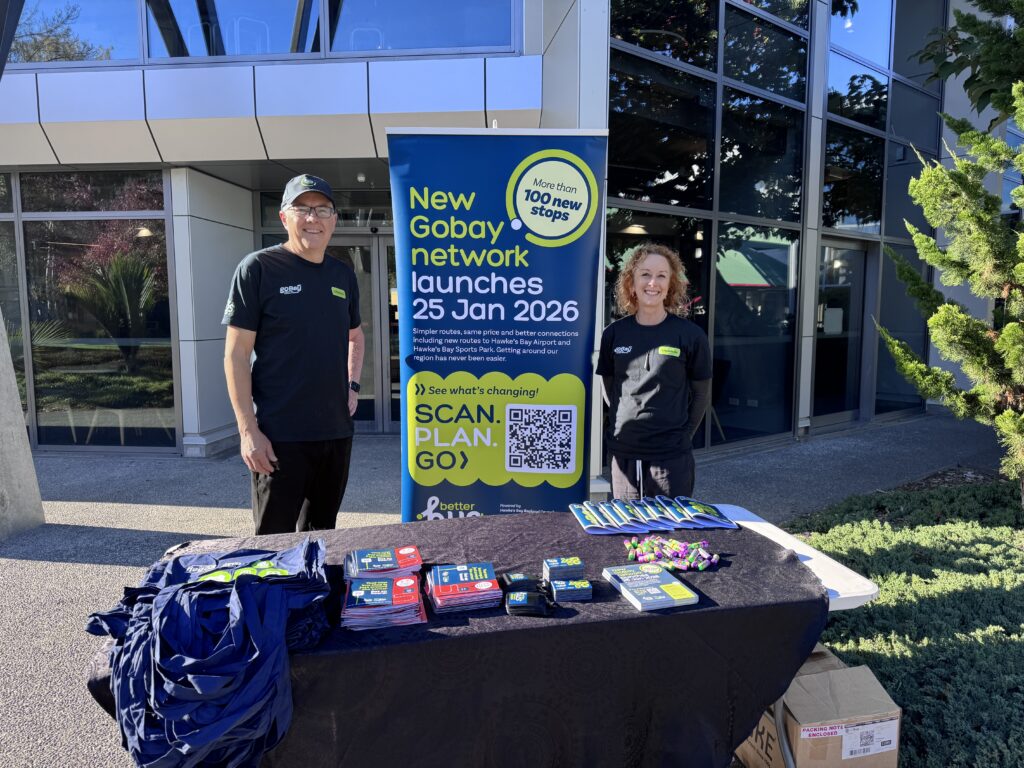
- Delivery: Worked alongside the HBRC team to complement a multi-channel campaign featuring paid digital ads, social media Q&As, and physical distribution of collateral to over 30 types of locations (e.g., marae, pharmacies), event attendance and pop-ups.
The Outcome
Deliverables:
- Ambassador Programme: Two dedicated student interns and three community champions who rode buses daily to assist passengers.
- Community engagement: Attendance at approximately 40 community events over eight weeks.
- Agile engagement: Provide kanohi-ki-te-kanohi engagement as requested or address issues as required
- Digital campaign: Worked alongside HBRC on a dedicated marketing campaign and social media campaign
- Communications: Communications with key partners (e.g. councils) and key locations (e.g. Sports Park, schools) across Napier and Hastings
- Internal Comms: Weekly project updates to Council leadership and bus drivers to ensure messaging alignment.
Measures:
- Reach: 135,516 people reached via social media; 709,314 digital advertising impressions.
- Engagement: 42,227 website sessions and nearly 7,000 visitors who engaged deeply with journey-planning tools.
- Events: Over 40 in-person events attended, including street corner sessions to address localised infrastructure concerns
- Sentiment: Strong positive media pick-up and national reach (RNZ, 1 News, Stuff).
Client Feedback:
“No one left behind.”
“I just wanted to say a genuine thank you for the way Rebecca and Kelly have both approached this project. Their contribution has gone well beyond the professional brief — the care, personal investment, and genuine interest in how this landed for the community has been very evident, and it’s been hugely appreciated by the team. They’ve been an absolute pleasure to work with.” – Transport Manager, Russell Turnbull
Key Insights
The project was complex due to the campaign timing (the campaign was during the summer holidays), the MyWay service which higher needs groups had come to rely on was ending, new bus stops were being installed by Hastings District Council and Napier City Council, , and there was a spotlight on how rate payer money was being spent.
Despite these risks, the campaign was largely received well by the wider community.
What worked?
- Agility: Pivoting to hold street-corner sessions when residents pushed back on stop locations.
- Going to them: We met people where they were, whether on the bus, at community markets, at group lunches, at EIT and more.
- Representation: Using champions who ‘look like me’, particularly for one of the target groups of people with disabilities, built immediate trust.
- Digital reach: The digital campaign was spread across many channels and used the friendly branding to create interest and lead people to the website.
- Incentivisation: Offering free fares during launch week encouraged low-risk trial of the new routes.
What other organisations can learn:
Engage early on infrastructure. Public opposition to new bus stops impacted the campaign and reduced the overall perception of the bus launch. Collaborate with local councils earlier in the process.
Target bespoke school channels. Reaching parents during holidays was difficult and required a more direct-to-parent strategy developed well before the school term ended
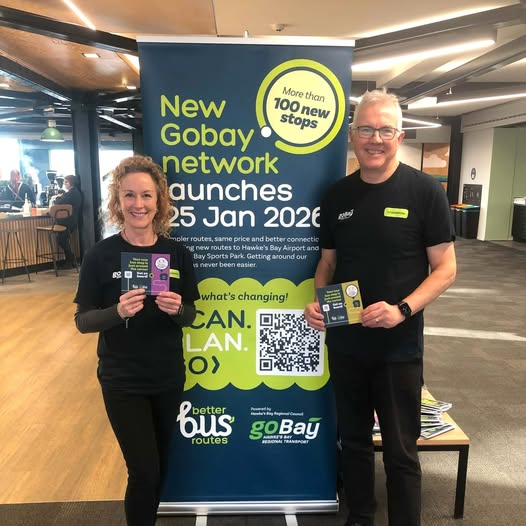
Hawke’s Bay Regional Council’s Transport Manager at the Hawke’s Bay Airport